

At what point do we actually become adults? Is it when we turn eighteen, get our first job, pay our own bills or start making decisions independently? We spend much of our childhood preparing for examinations and learning about the world. Yet nobody really teaches us how to navigate life itself. Society expects us to take responsibility and find our place in it. This is often learning the hardest lessons through experience. But have we ever stopped to consider what becoming an adult truly means? Are we simply growing older, following expectations and adapting to the world around us? or are we developing the emotional maturity, self-awareness and independence to think for ourselves? Perhaps it is time to rethink what we teach the next generation, and what adulthood should really represent.
There is another dimension to growing up that we rarely discuss: discovering what lies within ourselves. Nobody truly knows what goes on inside another person’s mind. Or what they dream about, what they fear or what potential remains undiscovered. We grow up surrounded by expectations, opinions and labels that can gradually shape how we see ourselves. Perhaps becoming an adult also means developing the courage to question what others have taught us. And to challenge our beliefs and discover the person we genuinely want to become.
Growing Older Shouldn’t Mean Growing Out of Wonder
When I look back at my childhood, I realise how much of my happiness came from simple things. I was fascinated by the universe of Harry Potter, imagining possibilities beyond the ordinary. I could spend hours playing Grand Theft Auto, not necessarily for the missions, but for the freedom to explore the map, discover hidden places and see what was around the next corner. Asterix introduced me to humour. I was equally fascinated by science, space exploration and television programmes that revealed the mysteries of the universe.
Looking back, I notice a common thread running through these memories: curiosity. I wanted to explore, discover, understand and experience things for myself. I didn’t need a particular destination or a reason to be excited. The journey itself was enough. It makes me wonder how much of that natural enthusiasm we gradually put aside as we grow older. When did exploration become a luxury? When did curiosity become less important than productivity? Perhaps becoming an adult shouldn’t mean leaving those parts of ourselves behind. Maybe we simply need to find new ways to express them. After all, the world hasn’t become less fascinating. Perhaps we have just become too busy to notice.
What subjects fascinated you, what adventures did you imagine, and what made you lose track of time? Perhaps you loved building things, exploring unknown places, reading stories, solving problems or discovering how the world worked. Look beyond the activity itself and consider what it awakened within you. Was it curiosity, freedom, creativity, excitement, connection or a desire to explore the unknown? These early experiences may reveal patterns that still matter today. Perhaps some of your childhood passions deserve a place in your adult life. We often spend so much time planning where we want to go that we forget to look at what has always inspired us. What if the next chapter of your life began by revisiting the things that once made you feel most alive?
Moondust
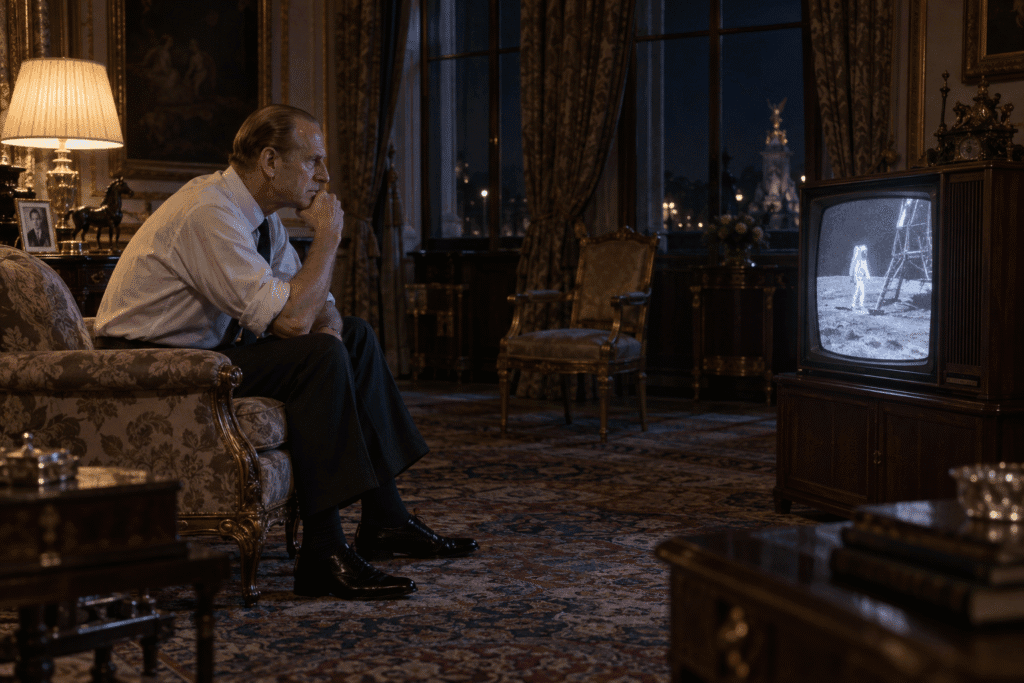
In the Netflix series The Crown, Season 3, Episode 7, titled Moondust, Prince Philip faces an unexpected period of dissatisfaction. Despite his royal position, privileges and responsibilities, he struggles to find fulfilment in his own life. He begins questioning his achievements and wonders whether his existence has a greater purpose. Philip has everything that society might associate with success. He is a prince, married to the Queen, surrounded by privilege and connected to some of the most influential people in the world. Yet something is missing. His position does not necessarily give him meaning. His responsibilities do not automatically bring fulfilment. He feels disconnected from the person he once imagined he would become. Looking for inspiration, Philip becomes fascinated by the Apollo 11 mission. The astronauts represent something extraordinary. They have travelled further than any human being before them. They have achieved what previous generations could only imagine.
For Philip, their journey symbolises courage, ambition and the possibility of going beyond ordinary human limitations. He eventually meets the astronauts, expecting to encounter remarkable individuals with extraordinary wisdom and perspective. Instead, he finds three relatively ordinary young men. They behave like children, laugh, joke and seem more interested in their immediate experiences than in the profound significance of their achievement. Philip feels disappointed. Philip struggles to understand how someone can accomplish one of humanity’s greatest achievements without appearing fundamentally transformed by the experience. He had placed these men on a pedestal. He expected them to possess some extraordinary understanding of existence. Instead, he discovers that remarkable achievements do not necessarily produce remarkable wisdom.
Before meeting the astronauts, Philip encounters a group of clergymen brought together by Dean Robin Woods. Woods has established a place where priests can reflect on their lives, discuss their struggles and rediscover their sense of purpose. Philip initially dismisses the initiative. He believes people overcome dissatisfaction through action rather than conversation and reflection. He even mocks the idea of bringing together priests who have lost their direction. When he eventually spends time with the group, Philip begins recognising familiar feelings in their experiences.
He eventually opens up about his personal struggles and develops a profound friendship with Robin Woods, which lasts throughout their lives. This unexpected connection teaches him the value of honest conversations, human connection and finding inspiration in people who do not necessarily possess extraordinary achievements, but who have the courage to question themselves and share their experiences.
Nobody Has It All Figured Out
We grow up believing that adulthood is a destination. We imagine that one day we will reach a certain age, understand how life works, establish ourselves and finally feel confident about our decisions. Some people have successful careers but feel completely lost. Others have families, mortgages and financial security but still question their direction. Some appear confident while privately wondering whether they made the right choices.
Some people have successful careers but feel completely lost. Others have families, mortgages and financial security but still question their direction. Some appear confident while privately wondering whether they made the right choices. We spend so much time trying to become the adults we imagined as children that we forget something important: nobody actually knows everything.
There is something liberating about realising that nobody has it all figured out. We spend years believing that adulthood comes with a manual, that successful people possess some secret knowledge, and that everyone else understands something we haven’t quite grasped. Yet behind closed doors, almost everyone is navigating uncertainty, questioning decisions and trying to make sense of their experiences.
Final Words
Growing up also means recognising how much of our identity has been shaped by external expectations. Family, education, culture, relationships and society all influence the person we become. From an early age, we learn how to behave, what success should look like and which paths we are expected to follow. Without realising it, we can spend years building a life around expectations that were never entirely our own.
Discovering our identity requires a willingness to look beyond those expectations. It means recognising the difference between what genuinely matters to us and what we have learned to value because others consider it important. It means allowing ourselves to change, challenge old beliefs and explore different possibilities without feeling guilty about outgrowing previous versions of ourselves. There is no shame in starting again, changing direction or admitting that something we once wanted no longer reflects our priorities. Our past experiences contribute to our story, but they do not have to dictate its future chapters. We are not obliged to remain the person we were five, ten or twenty years ago.
Perhaps this is what nobody teaches us about being an adult. Life isn’t a qualification we eventually obtain, nor is maturity a destination where uncertainty disappears. It is an ongoing process of learning, unlearning, adapting and discovering. We will make mistakes, experience unexpected changes and occasionally feel completely lost. None of this makes us failures. It makes us human. Ultimately, adulthood isn’t about having everything figured out. It is about taking ownership of the life we are creating, rather than simply living the one that others imagined for us. It is about becoming comfortable with uncertainty while remaining curious about what lies ahead.
As a life coach, I can help you gain clarity, reconnect with what matters to you and move towards a more fulfilling life. Through meaningful conversations, reflection and thought-provoking questions, I will support you in exploring your possibilities and taking steps towards your goals. Let’s have a conversation about where you are today and how I can support you on your journey.