
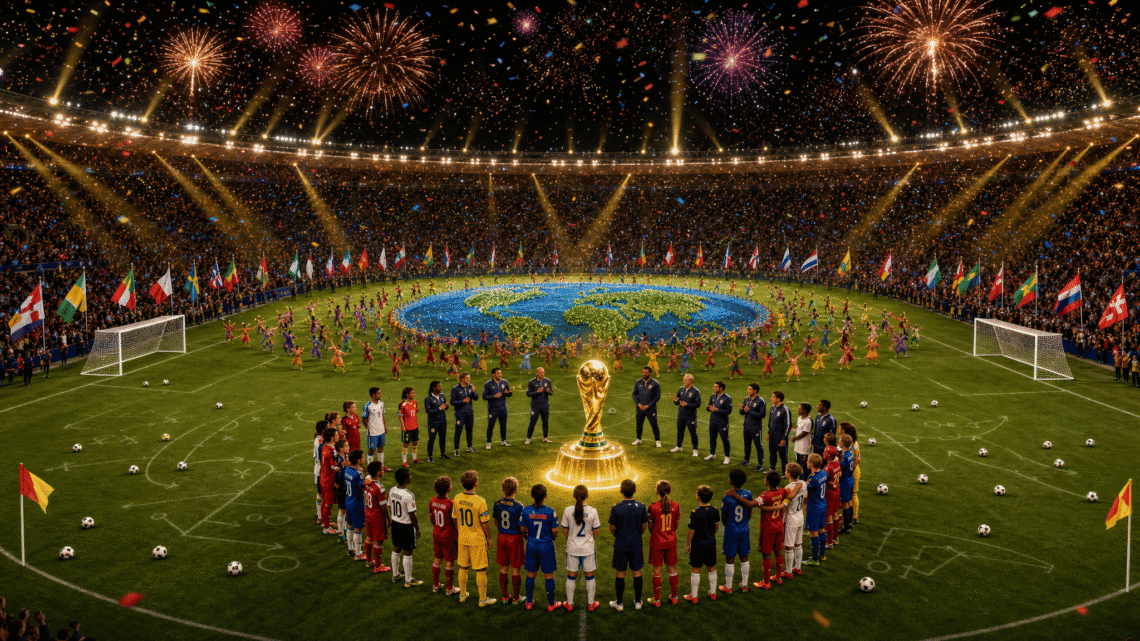
The World Cup is one of those rare global spectacles that manages to pull the entire planet into a shared rhythm. Billions of people from every corner of the world pause their daily routines to watch the same game. Strangers celebrate together. Families gather around television screens. Entire nations experience moments of hope, heartbreak, joy, and pride. The FIFA World Cup is the second greatest sporting event on Earth. But I believe it is much more than a football tournament. Beyond the goals, the tactics, and the trophies lies a powerful story about what it means to be human. It is a story of resilience in the face of adversity, of courage under immense pressure. But also of teamwork over individual brilliance, and of leaders who inspire ordinary people to achieve extraordinary things.
As a coach, I find myself looking beyond the final score. I have fascination for what happens behind the scenes: the conversations in the dressing room, the trust built over months and years, the culture created by exceptional coaches. Also the belief that can transform a group of talented individuals into a united team. The greatest football coaches don’t simply prepare players to win matches they shape mindsets, build confidence. They create purpose, and help people become the best version of themselves. So those lessons extend far beyond the football pitch. They apply to our workplaces, our relationships, our communities, as well as our own personal journeys.
In this article, we’ll explore why the World Cup captivates billions of people, what makes great coaches such remarkable leaders, and how football can teach us some of life’s most enduring lessons lessons that remain long after the final whistle has blown.
An Unexpected Routine
I’m someone who treasures the early morning. My days begin with meditation, quiet reflection, and the space to think before the world wakes up. That routine has become an important part of who I am. It grounds me and prepares me for the day ahead. But recently, life looked a little different. The heatwave made it difficult to fall asleep early. Instead of lying awake waiting for sleep to come, I found myself turning on the television to watch the FIFA World Cup. What started as a way to pass the time soon became something I genuinely looked forward to. At the same time, my work schedule changed. Because of Wimbledon, I started working later in the day and finished around 10 p.m. Surprisingly, those changes created a new rhythm. Watching football naturally found its place in my routine.
I began paying attention to the coaches on the touchline, the body language of players after setbacks, the celebrations after hard-fought victories, and the way entire teams responded to pressure. I have an admiration for the leadership, trust, communication, and resilience unfolding in front of millions of viewers. Every coach is shaping more than tactics. Every team is telling a story about belief, purpose, and what human beings can accomplish when they work towards a shared goal. Sometimes, the most meaningful lessons enter our lives when our routines change. For me, this World Cup arrived at exactly the right moment not just as entertainment, but as an unexpected classroom.
Where Great Coaches Come From
The most successful World Cup coaches don’t emerge from nowhere. They are shaped by decades of experience, failure, reflection, and influence. Many of them got inspiration by mentors who believed football is not just a physical game, but a psychological one. Marcello Lippi, who led Italy to victory in the 2006 FIFA World Cup, built teams rooted in trust and emotional stability rather than ego. His leadership style focused on calmness under pressure and collective belief. Joachim Low who guided Germany to triumph in the 2014 FIFA World Cup, was part of a generation that embraced sports psychology, preparation, and mental rehearsal as core tools of performance.
Gareth Southgate prioritized emotional intelligence, vulnerability, and psychological safety. His England teams have spoken about preparation that goes far beyond tactics preparing for pressure, failure, and expectation itself. Didier Deschamps have built winning teams around resilience and collective identity, where mental strength becomes just as important as technical ability. And behind many of these modern approaches is a shared influence: the growing world of sports psychology. Coaches learned that talent alone is not enough. The difference at the highest level is often invisible, it happens in the mind.
One of the most powerful tools used in elite sport is visualization. Not just “positive thinking,” but detailed mental rehearsal seeing situations before they happen, preparing emotionally and psychologically for pressure moments. While most World Cup coaches don’t always speak publicly about it in detail, the influence is clear across modern football. This approach is strongly influenced by pioneers in other sports. Phil Jackson used mindfulness and visualization to guide championship-winning teams in the NBA. Michael Phelps worked with coach Bob Bowman to mentally rehearse every detail of his races down to possible failures so that performance became automatic under pressure. And in football Roberto Martínez have emphasized mindset training, emotional preparation, and scenario thinking as part of elite performance culture.
You Are Your Own World Champion
Back in the 90’s Aimé Jacquet, the former manager of the French national football team, faced immense criticism and mockery from the French media. Critics frequently ridiculed his defensive tactics, his humble origins, his accent and his perceived lack of sophistication. With some journalists even suggesting he was unfit to lead the national team. Prior to the 1998 World Cup, Aimé Jacquet was the target of relentless. Behind the scene Aimé Jacquet was a pioneer in using video analysis for mental mapping. He had his staff create specific video montages of opponents, to show his players exactly where the spaces would open up. He made them visualize the execution. Despite the noise from criticisms he created a mental cocoon. He used this isolation to engage players in deep mental preparation.
He consistently spoke to the players as if they were already champions, forcing them to visualize the walk up the stairs of the Stade de France long before the tournament began. Thuram who had never scored for France before, scored twice at the semi final. He later described his goals as almost surreal. This was the result of the high-pressure mental focus Jacquet had instilled in the squad. When Laurent Blanc was suspended for the final (a potential psychological blow), the team didn’t panic because Jacquet had already mentally prepared the squad for “crisis scenarios.” On the Final several players said they felt they were ready and genuinely believed they will be champions. This confidence came from four years of preparation under Aimé Jacquet. To lift the world cup trophy after defeating the strongest team in the world.
The story of Aimé Jacquet serves as a powerful blueprint for personal resilience and the mastery of “internal weather” over external storms. We can be inspired by his ability to remain “straight in his boots” when peoplelabeled his methods unfit for purpose. Jacquet’s journey teaches us that when we are pursuing a grand vision, the mockery of others is often just a reflection of their inability to map out a future.
By creating our own “mental cocoon” and filtering out the noise of critics, we can focus on the incremental, disciplined work necessary for success. many of us live in fear of being our authentic selves because we anticipate the world’s judgment. To be your own world champion It is the courage to stand in the corridor of your biggest fears, looking at your authentic self in the mirror. And knowing with a calm and private certainty that you have already won because you refused to let the world’s noise dictate your value.
The Psychology of Nostalgia and the Magic of 1998
Remembering positive experiences from childhood is a well-studied topic in psychology and neuroscience. These memories can influence emotional well-being, identity, resilience, and even how people cope with stress throughout life. Positive childhood memories often stay with us because emotionally powerful experiences strengthen how the brain stores long-term memories. Moments filled with excitement, celebration, and a sense of belonging activate brain systems involved in emotion and memory.
For me, the 1998 World Cup was one of those unforgettable moments. It was my first World Cup, watched at home, and seeing France defeat the mighty Brazil made it special. I remember cheering for every goal, hearing cars honking and people celebrating in the streets. And watching Zidane lift the trophy, and seeing millions of people gathered on the Champs-Élysées. Those joyful memories remain vivid because they were shared with an entire nation. And tied people to such a powerful emotional experience.
Science suggests that these positive recollections provide a sense of security and belonging. Which helps individuals navigate stress and maintain more optimistic outlooks. By drawing on the warmth and confidence experienced in moments like a shared national victory, adults are often better equipped to build healthy relationships and approach challenges with a greater sense of self-worth.
Final Words
Football at its core is a rehearsal for reality. It is a game where the boundaries of a white line contain all the chaos, triumphs, and heartbreaks of a human life, compressed into ninety minutes. From the sport and the legendary coaches who master it, we learn that success is rarely a straight line; it is a series of adjustments made under pressure. We learn that failure is not a permanent state but a necessary data point. A lesson in resilience that teaches us to stand up, dust off, and go again before the whistle blows.
Great coaches show us that talent might win a moment, but discipline, preparation, and the humility to be part of something larger than oneself are what sustain a legacy. They teach us that the most important play is always the next one, and that the character we build in the quiet hours of practice is ultimately what defines us when the stadium lights are at their brightest. Ultimately, the greatest lesson the beautiful game offers is the transformative power of unity. On the pitch, individual backgrounds, languages, and egos must dissolve into a singular, collective heartbeat.
This spirit of togetherness transcends the sport, reminding us that in a fractured world, our greatest achievements come not from standing alone. But from the shared sacrifice and common purpose that bind us together. Whether in a stadium or a community, it is the invisible thread of unity that turns a group of individuals into a force capable of the extraordinary.