
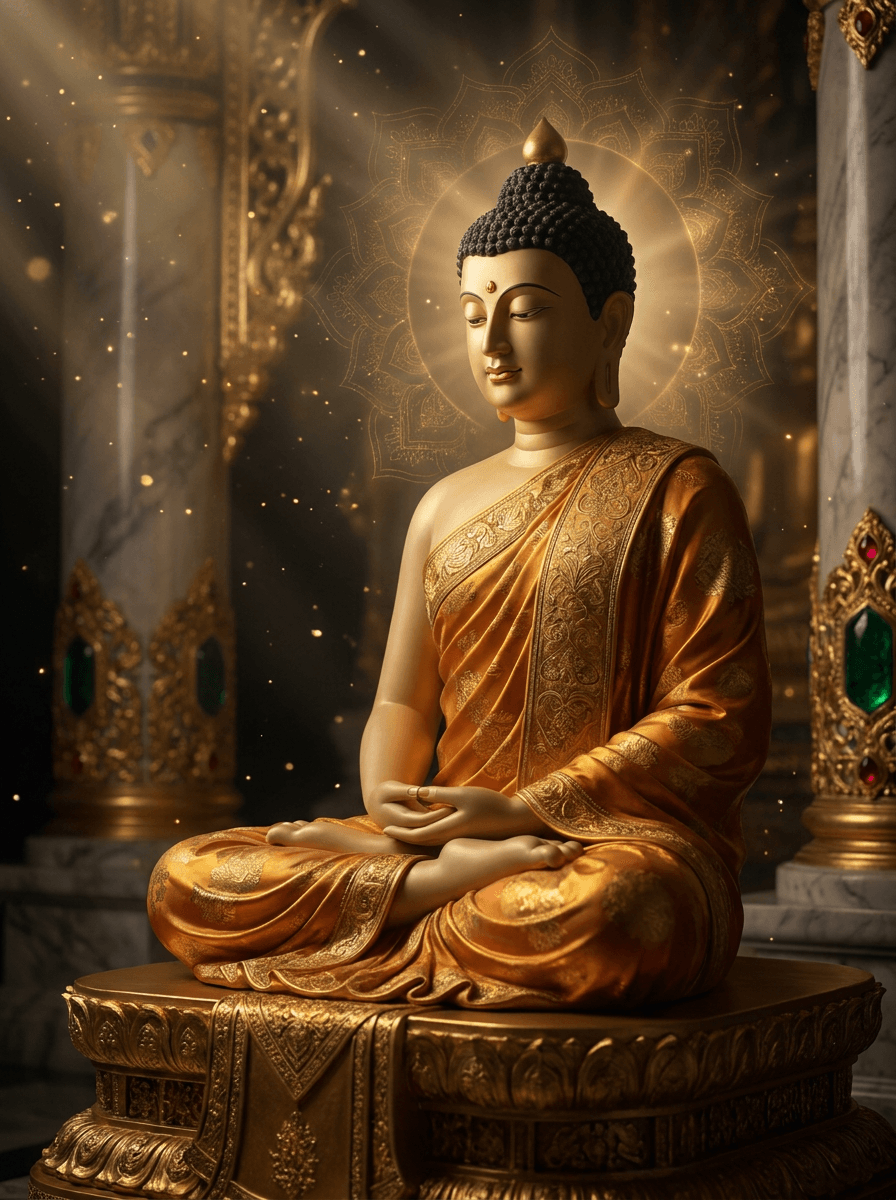
It started in the most ordinary way. I was in the kitchen, cooking, moving through the usual motions nothing special, just another moment in a busy life. And like many times before, I put on a random podcast. But this time, something landed. I was listening to monk Gelong Thubten on the Diary of a CEO podcast, and within minutes and felt something shift deep inside me. He spoke about mediation in a way I had never really heard before. He shared his experience of a retreat in Scotland, where he spent time in silence, facing himself in a way most of us rarely do. No distractions. No escaping. Just being.
And he said this experience changed his life. Not because everything suddenly became easy but because he learned how to relate differently to his thoughts, his emotions, his discomfort. He also mentioned as a practice of being fully present with reality. And that changed everything for me. Because I used to think meditation was about calming the mind, reaching some kind of perfect stillness. But what if it’s actually about learning to sit with the chaos? To observe it, without needing to change it?
It’s a different different way of living for me. Less resistance. More presence. Less escaping. More acceptance. This led me to the exploration of Buddhism!
What is Buddhism?
Buddhism is, at its core, a simple and practical way of understanding the mind and living with more clarity. It began over 2,500 years ago with Siddhartha Gautama, often called the Buddha, which means “the awakened one.” He wasn’t a god, and he didn’t ask people to blindly believe him. He was someone who looked deeply at life at suffering, happiness, and the human mind and shared what he discovered. His starting point was very honest: life can feel uncomfortable. Not just in obvious ways like pain or loss, but in subtle ways too stress, dissatisfaction, always wanting something more or different. Buddhism calls this dukkha, often translated as suffering or unease.
Instead of avoiding this reality, Buddhism invites you to understand it. It teaches that much of our suffering comes from attachment clinging to things we like, resisting things we don’t, and believing our thoughts without questioning them. We chase pleasure, avoid discomfort, and try to control life… But life keeps changing anyway. So what’s the alternative? Not withdrawal, but awareness.
It offers a path to observe your mind, rather than be controlled by it. Through practices like meditation, mindfulness, and ethical living. One of the key ideas is detachment. Not becoming cold or distant, but learning to experience life fully without gripping onto it. To enjoy what’s here, without needing it to stay forever. To face discomfort, without running away. It suggests that peace isn’t something you find by changing everything around you, but by changing your relationship with what’s already here your thoughts, your emotions, your experiences. In a noisy, fast-moving world, Buddhism is an invitation to pause. To sit, observe and to slowly understand yourself more deeply.
Exploring Buddhism
Since I’ve listened to that podcast I became eager to learn more about Buddhism. Out of curiosity to learn about us as human beings. And out of curiosity about the mind, mostly. How it works, how it creates stories, how it clings and resists. I notice how easily thoughts can pull me into the past or project me into the future, and I’m starting to question whether I have to follow them every time. Buddhism doesn’t seem to ask me to suppress the mind, but to observe it. To sit with it. To understand it.
What I’m most curious about right now is silence. Not just the absence of sound, but the experience of being with myself without distraction. In a world that constantly pulls attention with notifications, news, noise and stimulation. Silence feels almost unfamiliar even uncomfortable at times. Because in those moments of quiet, there’s nowhere to hide. My thoughts become louder. Patterns reveal themselves. My inner dialogue steps forward without filters. I’ve started to notice how quickly the mind wants to escape to reach for something, anything, to avoid staying there.
But I’ve also learned that I can stay. Not perfectly, not always peacefully but enough to begin understanding what’s happening inside. To see the habits of thinking, the loops, the reactions. And sometimes, just observing them creates a small space. Still, it raises a question I keep coming back to: Will I stay… or will I run? Will I sit with what comes up, even when it’s uncomfortable, unfamiliar, or confronting? Or will I distract myself, escape, and avoid meeting myself more deeply? But maybe that’s the point not to force comfort, but to build the capacity to remain. To sit in silence, not as an enemy, but as a place where something real can emerge.
What Did I Learn So Far?
I want to be honest with you these days, I face rejection a lot. Whether it’s opportunities that don’t work out or trying to step into new spaces in coaching beyond 2bLimitless. The only place that remains constant for me to keep showing up to the alumni mentoring sessions. The only place where I stay connected, grounded and learn. Also looking for means to find my potential clients. It’s not easy at all! But outside of the uncertainty, doors that don’t open, and moments that test me, what’s been changing, though, is how I respond to it.
Through meditation and silence, I’ve been learning about detachment not taking rejection as something personal or definitive and observing my thoughts as they arise. I notice the doubt, the frustration, the urge to question myself… and rather than getting lost in it, I sit with it. It doesn’t make things instantly comfortable, but it allows me to embrace the challenge and the discomfort, instead of running away from it. But the thing I’m convinced about is it doesn’t and will never make me doubt myself as a coach in delivering value. But the most interesting thing for me is detachment, detachment from any opportunity that could be in front of me. Because I can’t control outcomes whether getting clients or joining an organisation. I don’t have all the answers and it’s more about enjoying the process.
Embracing Life
Alongside Stoicism, Buddhism has been teaching me something simple but not easy: to stay open. Open to opportunities, open to uncertainty, open to whatever door decides to open without trying to force it or control the timing. Instead of chasing the “perfect” path or waiting for everything to align, I’m learning to meet life as it is. Not idealised, not filtered, just real.
There’s a shift happening in how I approach things. Before, I might have been looking for the right moment, the right outcome, the perfect conditions. Now, it feels more about consistency showing up, staying engaged, and trusting that not every step needs to be extraordinary to matter. Just taking the next step, again and again. Buddhist philosophy, much like Stoicism, brings me back to acceptance. Not passive resignation, but a grounded willingness to work with reality instead of resisting it.
I went to France for the weekend to see my family, and more than anything, it felt like a real pause. A chance to disconnect from the pace of daily life. To step away from the noise, and just be present with the people who know me the longest. Of course, the journey itself wasn’t perfect. Delays, small incidents, trains not running as planned… But instead of resisting it or getting frustrated, I embraced it as part of the experience. Accepting that not everything needs to go smoothly to be meaningful. Observing my reactions, choosing patience over tension, and letting things unfold as they do.
Final Words
In a way, those obstacles in my journey became part of the break too. A reminder that I don’t need perfect conditions to feel at ease. Just the willingness to stay present, adapt, and move with whatever comes. Aaron Doughty often talks about manifestation in a way that sounds surprisingly close to Buddhist philosophy especially when it comes to detachment and letting go. In manifestation, there’s this common trap: wanting something so badly that you create tension around it. You think about it constantly, you measure its absence, you try to control how and when it should happen.
That energy of grasping actually keeps you stuck. His message is simple: set the intention, but then let go of the need for it to happen in a specific way. That’s where the link to Buddhism becomes clear. Buddhism teaches that attachment clinging to outcomes, identities, desires is a major source of suffering. The more tightly you hold onto something, the more you create resistance when reality doesn’t match your expectations. Letting go doesn’t mean you stop caring; it means you release the emotional dependency on the outcome.